
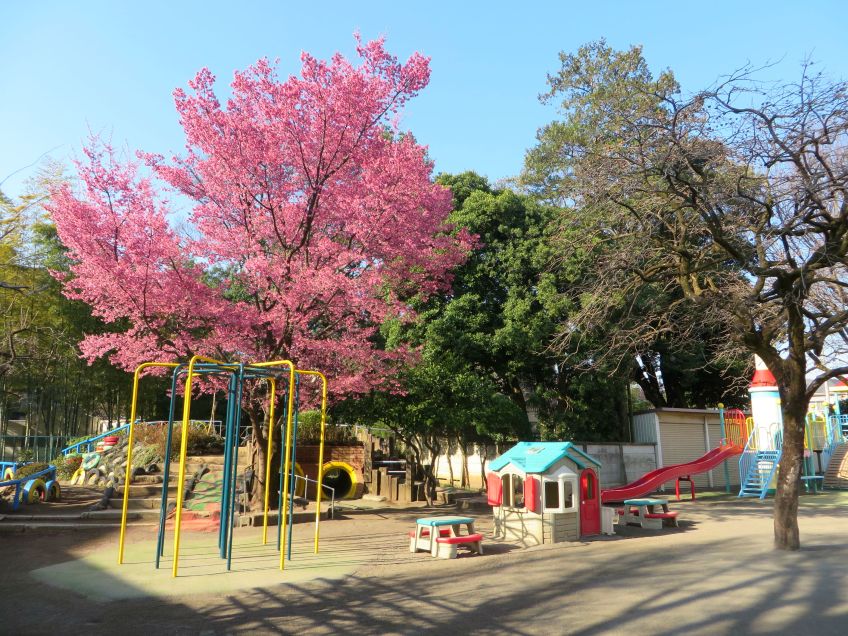
Cherry blossom tree blooming at the kindergarten I work at, just in time for their graduation ceremony. Spring is nearly here, finally.
Love it or hate it. Please read this before applying for a kindergarten job in Japan.
Between monitoring stats, comments and emails, one of the most popular topics it seems for people who stumble across this site is information on how to become a kindergarten teacher in Japan and what it entails. So I thought I’d write a bunch of stuff here to give people an idea of what my life’s like on a daily basis.
I really like my job, largely due to the great relationship I have with my school. But I also feel the job itself fits well with my personality. I’m creative, like to have a laugh and hate sitting about. This job keeps me on my feet all day, and while it’s tiring, I believe if you do it well it’s the most rewarding teaching experience you can have.
It’s not for everyone. I know people who shudder at the thought of having to teach kids this young. This isn’t the type of job you can do just to pay the bills. You have to be into it or you’ll hate it. I’ve worked with teachers before who don’t like kids and don’t even like Japan. They’re just here to make money. I don’t quite understand it. I guess I’m just saying if you really don’t think you’ll like the job, please don’t apply. It’s a waste of everyone’s time. If you think you’d have a blast though, then read on and see if it’s for you.
The Basics
I teach at a Japanese kindergarten, not an international school. All the kids and teachers are Japanese, bar me and any other English teachers who work there. I teach English to all the kids: I don’t have my own class, but go round the school teaching to every one. There are 600 kids.
Grades are split as follows: Nen Sho (three years old) Nen Chu (four years old) Nen Cho (five years old). I also teach special classes for two year olds who are accompanied by their parents. Generally speaking, I’ll teach all the Nen Shos one day, then all the Nen Chus the next etc.
Unlike ALT jobs whose hours and schedule are pretty much set in stone, every day for me is different. Some days I teach, some days I do special lessons in the pool, some days I go on field trips. I teach inside and outside. My schedule changes with zero notice. If you have the flexibility to adapt it’s no problem, but I’ve known teachers who freak out when they are told in the morning they have to teach 100 kids as a group in the hall as opposed to their regular lessons in the classroom.
Bottom line is that English is part of the school curriculum in Japan, but not the main focus. So we have to fit in to whatever the schools want. Have a think about whether you are OK with this.
Seika & Kagai
Simply speaking there are two main components to my job: seika and kagai. Seika is the morning classes for all the students. Kagai is extra curricula stuff – parents who pay extra for their kids to learn extra English in the afternoon.
[Seika]
Seika lessons range from 20-30 minutes and you’ll teach between 4-6 lessons in the morning. For some eikaiwa teachers that may seem like a small about of actual ‘teaching time’. But believe me, teach a full three hours of seika and then come back to me. It’s hardcore: singing, jumping about all morning, often without air-con. Energy conservation is key, knowing when to turn it up and also knowing when to tone it down – all the while keeping it exciting for the kids. It’s a fine art. Each month we have a new topic to learn about: animals, sports, family, clothing etc. Seika classes have about 30 kids.
[Kagai]
Kagai lessons run after lunch. With my company they last 50 minutes and you can have between 1-3 of these lessons. They are less intense. Unlike seika where the tables and chairs are cleared away, kagai students sit at tables, have textbooks and there’s writing practice etc. You get to know these kids way more personally, interacting with their parents and so on. Kagai classes range from 1-12 students.
Some days you may have only 4 seika and 1 kagai. That equates to 2hrs 50 minutes of teaching. But you have to remember you are with the kids for the whole day even if you are not teaching. You greet them in the morning, may have to ride the kindergarten bus and always eat lunch with them. You do not get a break. You do not get to leave the KG for downtime. If you want personal space, forget it.

Dressed up for graduation
A typical day for me in Tokyo
So what does a typical day for me look like? Well I live in Central Tokyo but my current school placement is 90 mins away. Far, eh? Some get lucky with minimal commutes but the majority of people I know average out at about an hour. Keep this in mind if you want to live and work in Tokyo. I actually don’t mind my commute though: I always get a seat and it’s one train the whole way, no transfers. I sleep, read, listen to music.
I’m up at 6.15am and on a train at 7am. At 8am I chill out for a bit at the station on the other end and eat breakfast, have a coffee. I arrive at the kindergarten at 9am, dump my bag upstairs, come back down and ride the kindergarten bus at 9.10, picking up some of the kids. Seika lessons start at 10:20 and I’ll teach til 12:00 or so, then eat lunch with the kids in the classroom. After lunch I may or may not have another few seika, or play outside for a bit in the sun before the kagai lessons in the afternoon. The day flies by, it really does. Finishing time varies from school to school and depending on your schedule. Some days you may be lucky and get out at 2.30pm, others 5pm etc.
What is a kindergarten teacher anyway?
“I feel like a clown.” “I feel like I’m a babysitter.” “I feel like I’m looking after kids at summer camp.” These are often complaints I hear from other teachers. Hell, I say and think it myself sometimes. But the truth is we are all of these things, so deal with it. These kids are toddlers so what do you expect? For them to be reciting Shakespeare? The very fact that a three year old comes into your class at the start of the year and ends it by being able to say his name, how he’s feeling, and follow simple conversation structure in a foreign language should be rewarding enough. Three years ago he wasn’t even alive! Remember that.
Yes my job is to teach English. But it’s also to help with life learning and promote internationalisation. For the majority of these kids, I will have been the first foreigner they have ever had any interaction with. I’m a foreign concept. So while language teaching at this age is important, it almost plays a secondary role. It’s all about being a good, fun, positive role model the kids. (You can read some more about the cultural benefits of being a kindergarten teacher in a previous post I wrote here.)

Field trip to the Airport Museum
Eligibility
Like 99% of teaching jobs, you must have a university degree (in any subject) to qualify for a visa to work as a kindergarten teacher in Japan. You don’t, however, need to be teacher qualified. I myself have a Psychology degree which I essentially have never used. But without it I would not be living and working in Japan. So the degree I once thought was useless is an invaluable tool, and one which work-wise I literally could not do without.
Gaijinpot and Ohayo Sensei will be your best bet for job listings online. Many require you to be currently living in Japan and have a valid visa, but some do not. I myself interviewed via Skype, then flew over once I was offered a position.
Money
University lecturing is where the money’s at in Japan with regards to teaching jobs. Kindergarten gigs, not so much. But I still live a pretty comfortable life and travel/party a fair bit. (Taiwan twice, Thailand, Myanmar, Bali, Sumatra, Java in the last two years.) Travel expenses are paid and I get two weeks summer / two weeks winter vacation. Kindergarten salaries are on par with those of ALTs: 260,000 starting range and eventually rising to 320,000+ with X years of experience. If you land a job that requires you to teach your own class, you can increase this to 350,000 and beyond. Accredited teachers will start at around 400,000. Do not accept a job under 250,000, though many companies are chancing their arms and offering 200,000. Ridiculous.
Housing
International school teachers with an accredited teaching license from their home country will be able to enjoy subsidized housing, as well as a much higher salary. For those without licenses, such as myself, it’s up to the individual to find their own accommodation. When I first moved to Tokyo in 2012, I actually found a random room in a share house on craigslist. It served its purpose at the time, but you never do know who you will be sharing with, so it is better to get your own place if possible. There are many real estate companies out there who can help you find the perfect place. It’s also worth noting that rent will be much cheaper if you choose not to live in Tokyo. Sapporo, for example, is still a major city but with much more affordable options. So if you were searching for Sapporo a good choice would be Sapporo Real Estate Agents.
So what do you think?
Do you want to be a kindergarten teacher in Japan? I’m still here and I’m still doing it because I enjoy it. I’ve worked in jobs before that I have disliked and vowed never to do it again. This is my third year as a kindergarten teacher and I feel only now am I preforming at 100% in terms of creativity and classroom management. It takes time to perfect.
Not to blow my own trumpet (OK I will) but I’m bloody good at my job. But I think the reason is because I enjoy it. Sometimes when you have a job you like it doesn’t really feel like working at all. (Remind me to read this last line next time I have a heavy cold and have to teach six seika back-to-back with no sleep.)
🙂
Like IKIMASHO! on Facebook here

 IKIMASHO!
Do you have any advice on how to get a job behind the deli counter at a Japanese Supermarket?
Great post. This was one of my dream to teach and travel.. Now I’ve changed my schedule. Hope to travel, not teaching any more.. 😀 #Spezio
Can you offer any advice on the Asian snooker circuit? Only joking, well done mate!
This is a great breakdown of what the teaching experience is like in Japan. I see some similarities to my time teaching English in South Korea a few years ago. Great pics too 😀
Loved this post, especially the photos which reminded me of some of your past posts (the sumo wrestling day!). Keep it up!
hi,
I’m a kindergarten teacher here in the Philippines and I am planning to apply in Japan.. I know Japan is using thematic instruction but I don’t have the knowledge how it is done..With my very humble heart, can you share me your ideas how to make thematic plans for kindergarten?
Thank you and I’m looking forward to hearing from you..
Truly,
Glenda
Pingback: Ongakukai / Music Festival at Japanese Kindergarten 2015 | Ikimasho!
I have been searching so hard for a job just like this. I’m currently an ALT but my contract is about to be up and I’ll be moving to Tokyo. My dream is to have the job you have – to work at a nice, happy public kindergarten… But searching through all these jobs, it seems that all of the ones for pre-school/kindergarten are private, international or juku schools. Do you know where else I could look? Or could you give me your opinions on different types of schools? Do you have any recommendations ??? Sorry for all the questions but your guidance would be so appreciated! Also, feel free to e-mail if you have the time ^_^;
(thought my e-mail would have been included in that last comment – it’s haleymiller@ezweb.ne.jp)
Pingback: HANG ON, ISN’T THIS SITE SUPPOSED TO BE ABOUT JAPAN? | Ikimasho!
Great article. I have been teaching kids for a long time in Japan too. I would love to chat with you. Can you send me an email to jduncalfe@gmail.com?
Feel free to contact me at jeglicopy@gmail.com
Hello, thanks for writing this! I also want to teach English in a kindergarten in Japan but a lot of ads I see online say you must have an Early Childhood Education degree or certificate. However, seeing as you don’t have one it makes me feel hopeful. Thanks so much.
I am planning on obtaining my TEFL Certification soon and my goal is to work as a Kindergarten teacher teaching English in Japan. I currently have 5 years experience teaching children ages 4-12 years of age but most of all I love my 5-7 year olds. I love getting to explore my goofy and creative side with my students and I think I would really have fun teaching English in Japan, especially to the Kinder age group. Are these jobs difficult to obtain quickly prior to arriving in Japan if you do not possess a degree and only a TEFL Certification with a few years experience teaching young children? I wasn’t sure if you knew much about this considering you work at a school that doesn’t primarily focus on English and only offer it as a component. If you are available to chat my email is meganeruss@gmail.com, I would love to speak with you!
Hi! Do you know a good website where i can find a job in Japain? Thanks! nice article by the way! If yoy get tired of Japan, China it is also a nice place to teach! 😉
http://www.ohayosensei.com/
Good luck!
http://www.7sis.info/#!english-summer-top/koeqq
Summer School with Seven Seas
Seven Seas International School is an immersive, all English kindergarten with a wide range of after school programs for students of all ages. A rigorous English language curriculum of reading, writing and conversation prepares students to enter competitive international schools, study overseas or function in a global environment.
The summer school at Seven Seas International School is one of Tokyo’s longest running, all-English summer programs.
Each term includes an awesome field trip where kids have the time of their lives with activities and lessons geared toward the theme of that week’s “mystery” destination. The program features intensive teaching–all in English–that is usually found only in boarding schools and dormitory-style programs.
The content of our renowned Thinker Class is used as a basis for all lesson content–ensuring children don’t simply play, but gain a solid academic foundation from exciting and innovative real-world activities.
http://www.7sis.info/#!english-summer-top/koeqq
I am planning to teach abroad in Japan, however I am not sure about the living situation. Whats your experience with finding housing and or whether a lot of schools offer some sort of housing. Thanks
Thanks for the great post! You’ve open my eyes to things unknown. I’m looking forward I teaching preschool in Japan but I might not be able to handle all the children like you! This insight help me to understand what I should look out for during my job hunt!
Thanks!
I. Salute you for your enthusiasm and skills teaching/playing with young children. You did an exceptional done!
Love what you wrote, doesn’t know your name and contact but in case you could contact me, would be fantastic. Maybe who knows in the future we can work together. Thanks a lot for great article and to have a, personality as you are, as to be successful with kids onky can as….
Thanks so much for your post. It’s really helpful. I’m going to study Japanese in Japan for 1.5 years this October. Many people have been asking me what am I going to do after graduate from the Japanese school. As I have experienced in teaching in kindergarten for 2 years, I’ve been thinking about being a kindergarten teacher too in Japan. But, I’m just not sure whether I’ll be qualified or not. I do have a university degree, means that I may be qualified. But, is there any other things I need? And by the way I’m from Indonesia, so I’m not an English native speaker. I teach in English though. Can you please answer my question? Thanks before.
Since you will already be in Japan and have finished school here then you will find it easier to get a job. But many jobs do require you to be from places like UK and USA etc even if you can speak English. But you will still be able to find work!
My eight years experience as preschool teacher at Paco Catholic School is the best years I had as a teacher . I truly love to teach kids and love to have fun with them too. Right now, i want to explore more with my life in different environment but definitely my passion in teaching preschooler will always be with me. It is my happiness
Thank you for sharing! 🙂
Hi there as an English teacher in Uganda I would like to put my grade on a higher level thanks
Hi~!
i really want to be a kindergarten teacher,and i love Japan
i wonder if i can be kindergarten teacher in japan too 😅 my major in university is English literature
I love japan, I love toddlers so this is great👧🏻🧒🏻👦🏻👦🏻🧒🏻👧🏻👩🏻🇯🇵😄👍🏻🌸
Hi, what about accommodation? Do they provide for you? And if you have kids, is it easy to move to Japan?
Gaia
Where did you get the kindergarten training before you join it?I would like to take training here and would like to open my own kindergarten in my country later.I have such kind of plan and i like Japanese kindergarten learning system.Would you please let me know the places where i can take training classes?
I just got training when I started my job, but if you want a proper qualification you would most likely need to go to university to get a license or qualification!
I have been teaching 19 years as a kindergarten teacher since 2000.
I had a great experience in Japan as a kindergarten english teacher. In 2002
I am 42years old now but i looking a job in Japanese kindergarten
If i have a vacancy in your beautiful country
I will do my job successfully with my 19 years experience.
Thanks to encourage us.
Well , i still am just a 17 year old teen from but i have always wished to be at a teacher specifically for younger children , maybe because i have been really close to the children in my school (we had a attached kindergarten) . I had helped there for quite a long time and that feeling kind of made me feel like i belonged there ,and the reason i choose japan well tbh the culture there is awesome but also how well the education system in japan is . Sorry for rambling ,but the question i had was after i am done with high school and the degree i may pursue , do i not need any special certificates such as first-aid , swimming etc ? I don’t have official experince with children will that not hinder my chances ?and last but not least is pursuing undergraduate studies in japan a good idea ??
Wow. This post really motivated me. I almost gave up thinking i’d never be able to reach because i’m kind of going through hard times. But i’ll try my best to fulfill this dream of mine ^-^
That’s was great experienced by yours and it can motivate me, I would like to ask if how to apply as kindergarten in japan
Great article, I enjoyed reading it. I am also an English teacher in a Japanese Kindergarten here in Gunma. I really love the kids, they are so adorable. It feels like we are a big family doing things together and the teachers are also really supportive, they allow me to do everything that I want to do in the classroom during my Seika and Kagai Classes. I enjoyed singing, dancing, playing simple esl games with the kids during my english classes. My typical day is just the same as yours, no downtime and I appreciate it. The more active my job is, the more productive I think I am. And Yes, the schedule is really changing from time to time so I always plan ahead just in case and flexibility is the key.
After reading your blog. I got to appreciate my job more.Thank you.
Jerrell I’m so glad you are happy in Japan and what you do!
What a great opportunity for a teacher like me. I am a teacher here in the Philippines and I would love to travel teach and travel. Teaching these kids would be fun. How can I apply?